
This post may contain affiliate links. I may earn a small commission at no extra cost to you.
If you’ve been posting on Pinterest, getting impressions, maybe even a few clicks… but still zero income, you’re not alone.
Most beginners assume traffic = money.
It doesn’t.
You can get clicks and still make nothing — because clicks alone don’t convert.
The missing piece is a simple Pinterest affiliate marketing funnel — the system that turns random traffic into actual sales.
Without a system, Pinterest is just noise.
With a funnel, it becomes predictable.
What Is a Pinterest Affiliate Marketing Funnel?
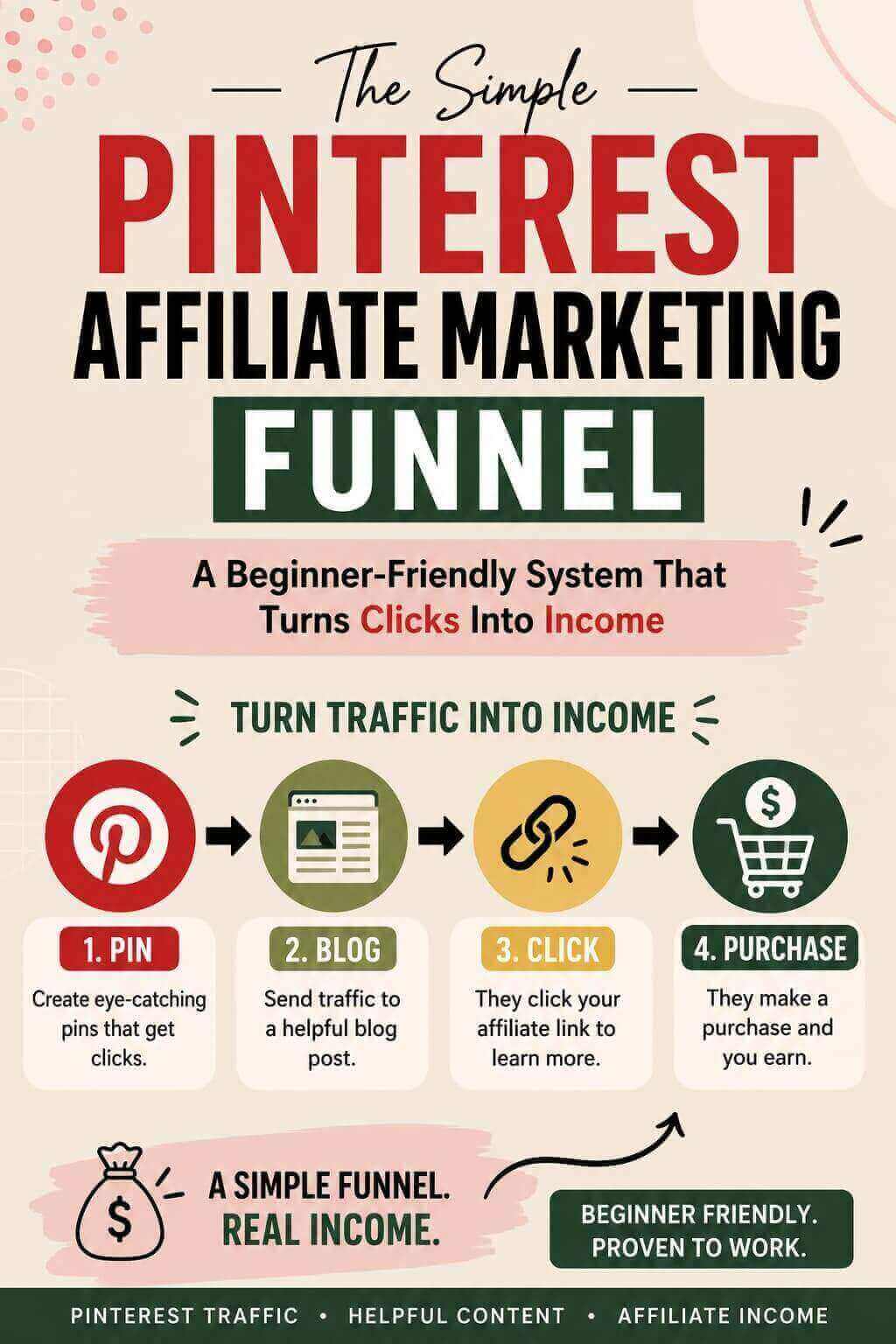
A Pinterest affiliate marketing funnel is a simple path you create to guide someone from:
Pin → Blog → Affiliate Click → Purchase
That’s it.
No complicated tech. No email list required (at least in the beginning).
But if you skip this structure and just drop affiliate links randomly, you’ll keep getting clicks… and still earn nothing.
Why Pinterest Traffic Doesn’t Convert Without a Funnel
Pinterest traffic is cold.
People don’t know you. They don’t trust you. And they’re not ready to buy instantly.
If you send them directly to an affiliate link, most will leave — not because your offer is bad, but because there’s no trust built yet.
A funnel fixes this.
It gives your audience:
- Context
- Clarity
- Confidence
Instead of pushing a sale, you guide them step by step — and that’s what leads to conversions.
Why Most Beginners Fail (And You Might Be Doing This Too)
Let’s be honest — most people on Pinterest are doing one of these:
- Posting pins without a clear goal
- Sending traffic directly to affiliate links
- Writing blogs with no conversion structure
This leads to:
- Low trust
- No engagement
- Zero conversions
Pinterest users don’t buy instantly.
They scroll → click → read → trust → THEN click your link.
If your content doesn’t guide them through that process, you lose them.
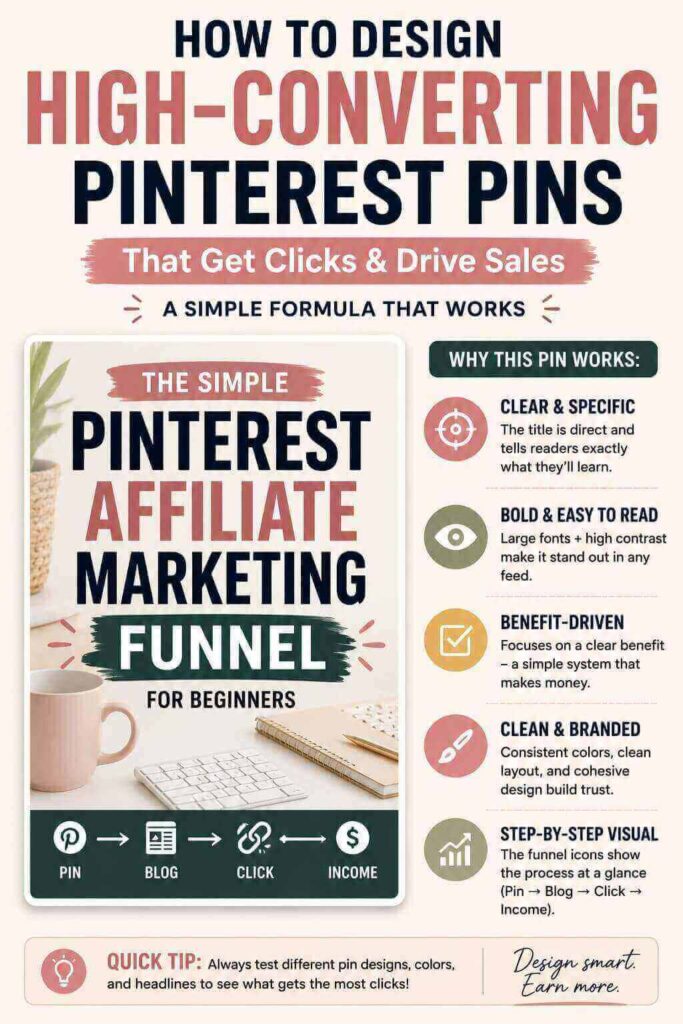
Step 1: Create Pins That Target the Right People
Your funnel starts here — and if this part is weak, nothing else matters.
You don’t need “pretty” pins.
You need clear, curiosity-driven pins that make people think:
👉 “Wait… I need to see this.”
Focus on:
- Beginner problems
- Mistakes
- “I was wrong” angles
- Specific outcomes
Example:
- “Why Your Pinterest Clicks Don’t Turn Into Money”
- “I Was Getting Traffic… But No Sales (Here’s Why)”
Step 2: Send Traffic to a Blog (Not Direct Links)
This is where most beginners mess up.
They try to shortcut the process and send users directly to affiliate links.
Bad move.
Most beginners try this shortcut — and it’s exactly why they never see conversions.
People don’t trust random links — especially on Pinterest.
Instead, send them to a blog where you:
- Explain the problem
- Share a solution
- Naturally introduce your affiliate tool
If you’re still confused about how Pinterest affiliate marketing works, read this first:
👉 Pinterest Affiliate Marketing for Beginners
Step 3: Structure Your Blog Like a Funnel
This is where conversions actually happen.
Your blog should NOT feel like a tutorial.
It should feel like: 👉 “This solved my problem… maybe it can solve yours too.”
Use this structure:
1. Hook (Relatable Problem)
Call out the exact issue they’re facing.
2. Reality Check
Explain why what they’re doing isn’t working.
3. Simple Solution
Introduce your method.
4. Tool Recommendation (Affiliate)
This is where you bring in your link naturally.
Step 4: Use Canva to Remove the Biggest Beginner Struggle
Most beginners don’t stay consistent because designing pins feels slow, confusing, and frustrating.
That’s exactly where they quit.
If you can’t create pins consistently, your funnel won’t work — Canva fixes that fast.
[ 👉 Start creating Pinterest pins faster with Canva ]
Instead of wasting hours trying to figure out design, most beginners use Canva to create clean pins in minutes — without overthinking it.
( 👉 Try Canva and see how fast you can create your first pin )
This simple Pinterest affiliate marketing funnel works only if your pins actually get clicks — and design plays a huge role in that.
Step 5: Guide the Reader to Take Action
Don’t just explain things.
Tell them what to do next.
At the end of your blog:
👉 Reinforce the benefit
👉 Remove hesitation
👉 Push action
If design is slowing you down, this is the easiest place to fix it — start using Canva.
{ 👉 Start with Canva here and fix your pin design problem }
Common Mistakes That Kill Your Funnel
Even if you follow the steps, these mistakes will ruin your results:
❌ No clear message in pins
❌ Weak blog structure
❌ No trust-building content
❌ Passive CTAs
❌ Inconsistent posting
If your pins aren’t getting clicks at all, your design is likely the problem — fix that first using Canva/Pinterest design blog
Final Thoughts (Read This Carefully)
Pinterest is not “post and earn.”
It’s: 👉 System → Consistency → Results
Once you build a working Pinterest affiliate marketing funnel, everything becomes easier:
- You know what to post
- You know where traffic goes
- You know how money is made
And most importantly: 👉 You stop guessing.
Leave a Reply